What does an RDW licence-plate check show, and what doesn't it?
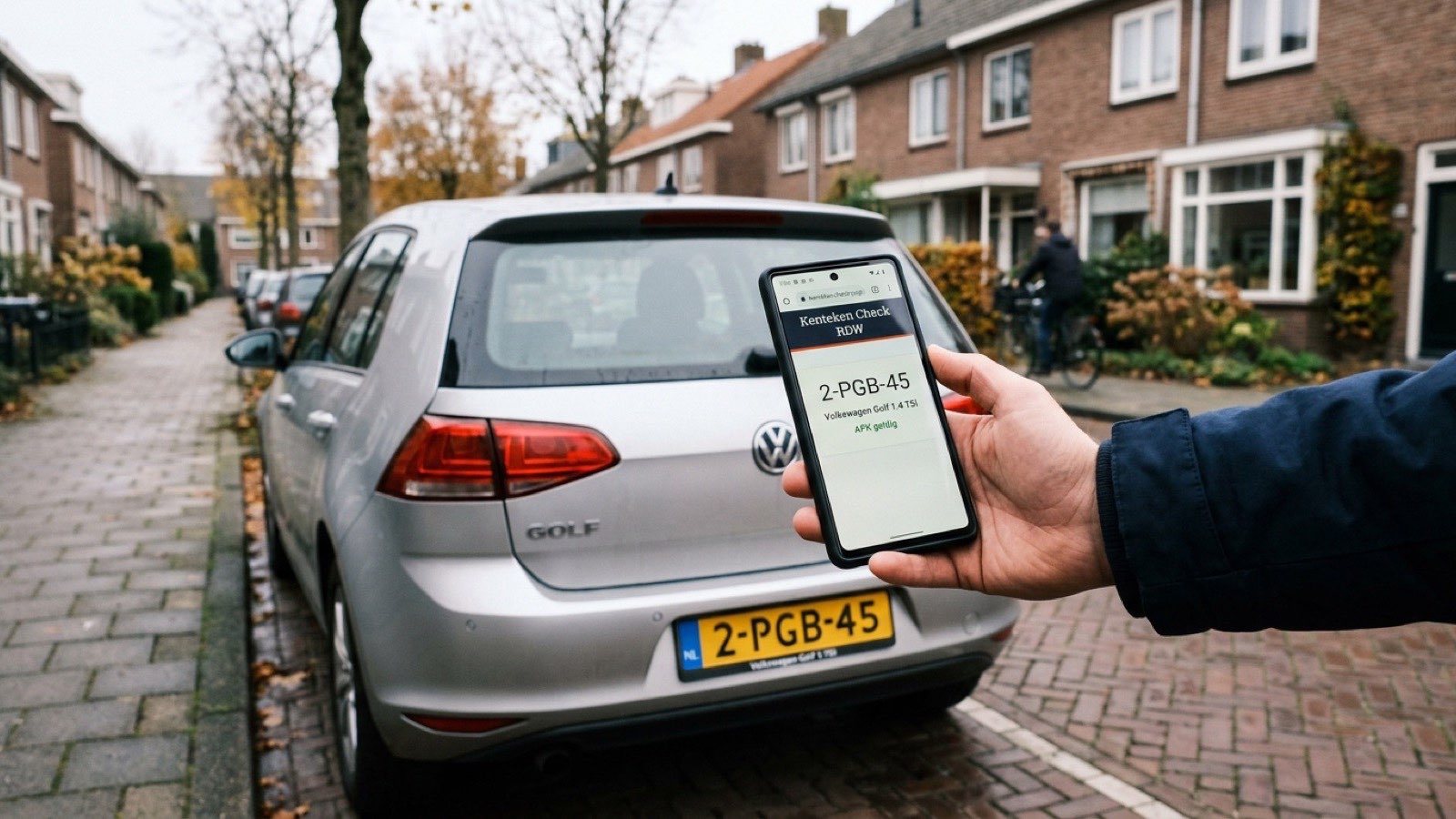
An RDW licence-plate check shows technical and fiscal details such as make, fuel type, APK expiry, open recalls, registered liability insurance, and a verdict on the odometer reading (consistent or inconsistent since 2014). The free open data that most plate checks run on, Plateop included, holds no accident history, service records, or owner name, and doesn't even carry an owner count, only the date of the last registration change. That count only shows up on RDW's own free checker at rdw.nl. For damage, servicing, or the full odometer history, a source other than the RDW register is needed.
An RDW licence-plate check in the Netherlands shows technical and fiscal details: make, model year, fuel type, APK expiry (the Dutch periodic roadworthiness test), whether an open recall is outstanding, whether liability insurance is registered, and a verdict on the odometer reading (consistent or inconsistent). It does not show accident history, service records, or the owner's name. The free open data that most third-party plate checks run on, Plateop included, doesn't even carry an owner count, only the date of the last registration change. That count only appears on RDW's own free checker at rdw.nl.
Applies to: the Netherlands (the RDW vehicle register) Source: RDW, via rdw.nl and opendata.rdw.nl Checked: August 2026 Main exception: RDW's own free checker at rdw.nl shows the owner count; the open data field that third-party apps query does not.
What Plateop pulls from the vehicle register
Plateop's Dutch vehicle data comes from four free parts of the vehicle register, no API key required, all part of opendata.rdw.nl:
- Base record (the Gekentekende_voertuigen dataset): make, trade name, colour, body type, weight, dimensions, APK expiry, recall flag, liability-insurance status and odometer verdict.
- Fuel and power (Gekentekende_voertuigen_brandstof): fuel type, power in kW, CO2 output, consumption, and for electric cars the WLTP consumption and range.
- Recorded defects: the actual faults noted at earlier APK inspections, with code and date.
- Defect reference list: a static reference table that translates each defect code into plain language.
These are the same fields that show up on any plate check built on this open data, not something specific to Plateop.
What you do get
| Category | Example fields |
|---|---|
| Identity and specs | make, model, year, colour, body type, weight, dimensions, seats and doors |
| Engine and emissions | fuel type, engine size, power, CO2 output, consumption, EV range |
| Inspection and registration | APK expiry, first registration date, date of the last ownership change |
| Legal and safety | open recall, registered liability insurance, odometer verdict, ownership-transfer eligibility (legal block on re-registration) |
The defects field is worth calling out on its own. RDW publishes, per plate, exactly which faults were flagged at a previous APK, down to the defect code. That's more detail than most buyers expect from free open data.
What's missing
What's missing here is missing structurally: not because Plateop leaves it out, but because the vehicle register simply doesn't hold it.
Ownership history. RDW never releases a name or address through a plate check; Dutch privacy law forbids it. Getting the registered owner's identity requires a formal request to RDW, at €9.20 per lookup. For a private individual, RDW asks the owner's permission first and gives them fourteen days to respond; if the owner refuses or stays silent, the requester gets nothing. No such consent is needed when the registered owner is a legal entity (a registered company); it is needed for a sole proprietorship.
Accident history. RDW doesn't record collisions or insurance claims. That data sits with insurers, not the vehicle register.
Service history. Which garage did what work, and when, isn't held anywhere at RDW. That stays with the workshop or the seller's own service book.
Even the odometer reading itself is thinner than most people assume. RDW has only recorded odometer readings since 1 January 2014, and what it publishes is a verdict, consistent or inconsistent, rather than the readings themselves. RDW does not show the individual figures in the free plate check, and not to third parties at all; only the registered owner or holder can pull them, free, in the RDW Vehicle Report (RDW-Voertuigrapport), using DigiD, eHerkenning, or an RDW certificate.
Why the owner count is the exception
RDW's own checker at rdw.nl does list the number of owners, alongside the odometer verdict and the technical data. That's not an open data field: it's a feature of RDW's own web tool, built on the full vehicle register behind the scenes. The open data API that apps like Plateop query only returns the date of the most recent ownership change, no count and no series. Anyone who wants the owner count has to go to rdw.nl directly, not the open data underneath it.
When you need more than the RDW check
Three situations sit past what the free RDW check covers. Wanting to know whether a car was ever written off or had an insurance claim means finding a source that pulls in insurer data, since RDW holds none. Wanting the full run of odometer readings rather than just the verdict runs into the same wall: the verdict is the only thing a free third-party plate check publishes; the registered owner or holder can still pull the underlying series free of charge in the RDW Vehicle Report, with DigiD, eHerkenning, or an RDW certificate. And confirming that servicing was actually kept up means checking the service book or calling the garage directly, because no government database tracks that.
What this means for a buyer
An RDW plate check is a solid first pass on the hard facts: is the APK current, does the fuel type match the listing, is there an open recall, and is the odometer reading consistent. For everything after that (damage, servicing, who owned the car before) the open data hits a wall: that information sits with someone else or isn't public at all, which is a limit of the register, not a flaw in the check. A Plateop report turns these free register fields into a single readable summary with an explanation of the odometer verdict, so you're not left working out what "inconsistent" means before making an offer. Check any car before you buy at plateop.com.
Sources
- RDW — RDW-Kentekencheck
- RDW — Kilometerstand controleren
- RDW — Gratis RDW-voertuigrapport aanvragen (free RDW vehicle report)
- RDW — Terugroepacties opzoeken
- RDW — Eigenaar voertuig opvragen
- Open Data RDW — Terms of Service
- Open Data RDW — Gekentekende_voertuigen (m9d7-ebf2)
- Rijksoverheid — Moet ik een WA-verzekering afsluiten als ik een auto of ander voertuig heb?
- wetten.overheid.nl — Wet aansprakelijkheidsverzekering motorrijtuigen (BWBR0002415)
- Rijksoverheid — Wie kan kentekengegevens van mijn auto opvragen?