What information is usually missing from a licence-plate check?
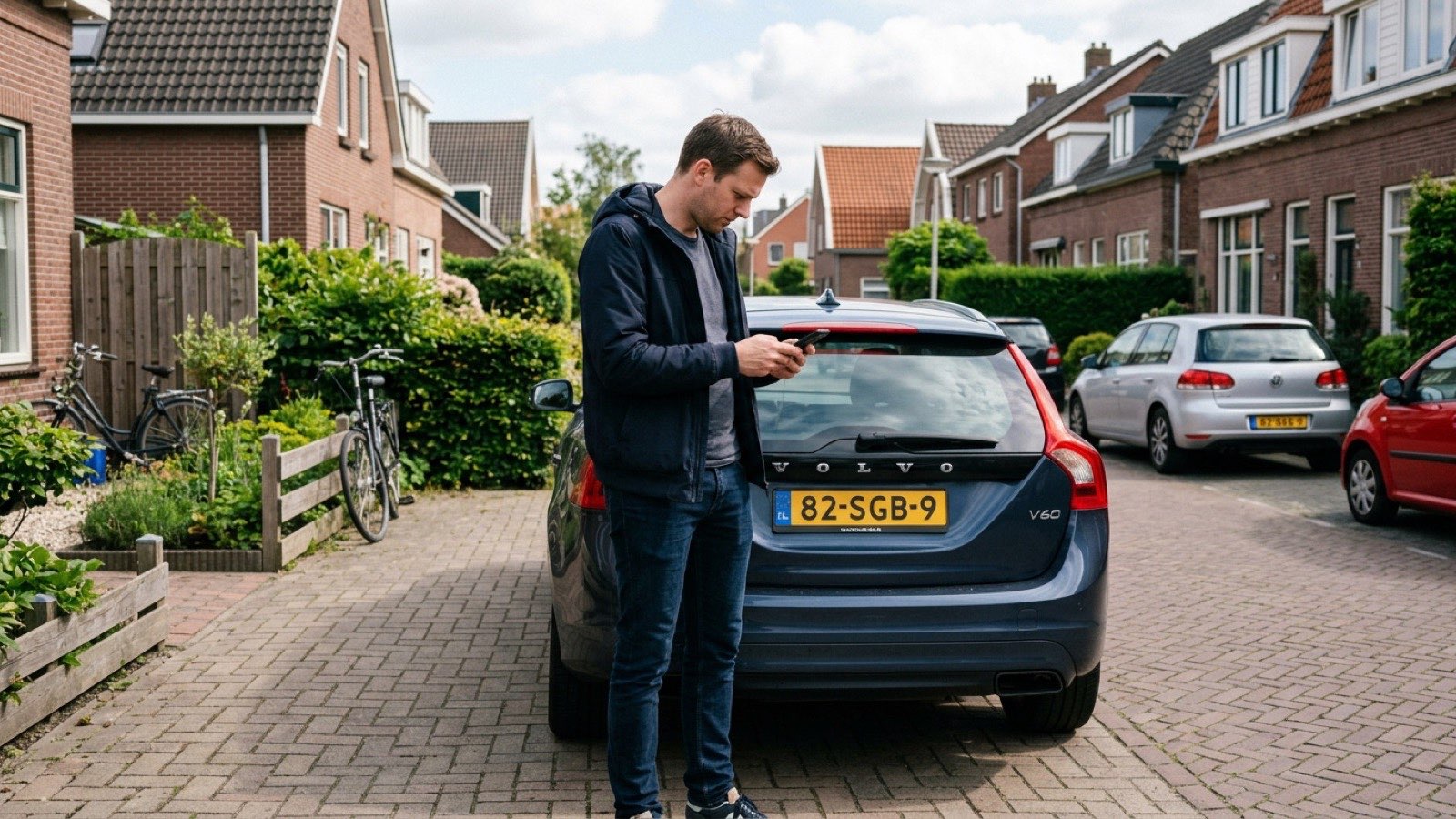
A Dutch licence-plate check, whether it's the free official one or part of a fuller report like Plateop's, shows what sits in the Dutch vehicle register: specs, APK history, recalls, and a verdict on the odometer reading. What falls structurally outside that comes down to four categories: damage repaired without an insurance claim, service history, a car's history before it was imported, and how many keys come with it. RDW's own Gekentekende_voertuigen dataset holds no field at all for damage, accidents, insurance claims, or servicing. That is not a design choice by any particular check; the vehicle register was never built to be a purchase history.
A Dutch licence-plate check, whether it's the free official one or part of a fuller report like Plateop's, shows what sits in the Dutch vehicle register: make, model year, APK expiry, recalls, and a verdict on the odometer reading. What falls structurally outside that comes down to four categories: damage repaired without an insurance claim, service history, a car's history from before it was imported, and how many keys come with it. None of these gaps exist because a check overlooks them. The vehicle register simply does not hold them, whichever provider is running the check.
Applies to: the Netherlands, the RDW vehicle register and the checks built on it. Source: RDW, via rdw.nl and the open data catalogue at opendata.rdw.nl. Checked: August 2026. Main exception: this covers what sits in official, publicly queryable data. A seller can still close some of these gaps with their own paperwork; a licence-plate check cannot do that for you.
What a licence-plate check does show
The base data is the same wherever the check is run, whether that's RDW's own site or a third-party report: technical specs, APK expiry, faults recorded at earlier inspections, any open recall, whether liability insurance is registered, and a verdict of consistent or inconsistent on the odometer. All of it comes from the same source, RDW's open data. What falls outside that does not change depending on who is selling the check.
Gap 1: damage that never became an insurance claim
RDW's own Gekentekende_voertuigen dataset, the base layer under nearly every licence-plate check, holds no field at all for damage, accidents, insurance claims, or write-offs. Even a hypothetical check with access to insurer data would only ever see claims that were actually filed. A dent the owner had resprayed and paid for out of pocket never passes through an insurer, so it never enters any register either, no matter how thorough the check built on top of that data happens to be.
There is one narrow exception. If RDW itself has issued a driving ban over damage to a specific vehicle, that shows up separately under the vehicle's status on ovi.rdw.nl, not in the open data most third-party checks run on: the underlying field exists there too, but RDW deliberately withholds its value outside its own site. That is RDW's own administrative decision, not a general damage database, and it only covers cases where RDW itself has stepped in.
Gap 2: service history
The same dataset carries no field for servicing. Which work was done, at which garage, and at what mileage is recorded nowhere in the vehicle register. That stays with the workshop or in the owner's own service book, and it does not automatically travel with the car when it changes hands.
Gap 3: history from before an import
For an imported car, RDW is explicit about where the import process stops. At the inspection required for import, RDW states: "We do not look at the technical condition of the vehicle during the inspection." That inspection identifies the vehicle and checks its paperwork, nothing more. Service, damage, or odometer history from the country of origin is not carried over into a Dutch register.
That reaches the odometer verdict too. RDW names "the vehicle is imported" explicitly as a reason for giving no consistent-or-inconsistent verdict, and RDW's own odometer recording only runs from 1 January 2014. For a car that spent time abroad first, the checked sequence in most cases only starts once a Dutch reading exists, never before. For the two largest sources of Dutch imports that has become more nuanced: since 13 January 2025 the RDW folds Belgian odometer readings into the register, and German readings joined on 3 February 2026 (see our guide on what a logical odometer reading means). For cars from other countries, the limitation still applies in full.
Gap 4: the number of keys, and other things no register tracks
Whether a car comes with one key or two sits in no government database, and never will. The same goes for the service book itself, spare parts, or accessories that belong with the car. These are not gaps in any particular check; they are facts that were never recorded by a public authority in the first place, because there was never a legal reason to record them.
Why this is the case
The vehicle register exists to identify a car technically, fiscally, and legally: is it roadworthy, has the tax been paid, is there valid insurance. It was never built as a purchase history. Damage data sits with insurers, servicing with garages, and keys with whoever happens to hold the car at a given moment. None of those parties is required to share their records with RDW, and RDW is not the body tasked with merging them. Any check built on the vehicle register inherits that boundary automatically.
How to close these gaps in practice
For damage without a claim, there is no substitute for asking directly and looking yourself. Ask the seller outright whether the car has ever had damage repaired outside insurance, and get an independent mechanic to check for signs of earlier repair work. Check the vehicle's status on ovi.rdw.nl too, in case RDW itself recorded a driving ban over damage at some point.
For servicing, ask for the service book and, where possible, call the garage named in it.
For anything before an import, compare the date of first registration with the date of first registration in the Netherlands, and ask for the original foreign registration document and the most recent foreign inspection reports.
For keys and accessories, the advice is the simplest of the four: ask at the viewing, and have both keys shown and tested before you sign anything.
What this means for a buyer
A licence-plate check is a starting point, not an end point. It confirms what has been officially recorded, and shows exactly where that recording stops. Everything past that depends on what the seller is willing to show and what an independent mechanic finds in person, not on a database that was never built to hold it. A Plateop report lays out the vehicle-register fields that do exist in one place, so you can put direct questions to the seller on precisely the points above instead of guessing which ones are still open. Check any car before you buy at plateop.com.